
Siblings: From Rivalry to Abuse
“Sibling abuse should be characterized as relationships involving repetitive, ongoing emotional and physical violence, in a context of power imbalance, with signs of harm and intimidation.”
~ Dr. Corrina Tucker, SAARA
The purpose of the SCAAR study is to understand how Canadian adolescent siblings manage conflict, the impact of those interactions, and the role of the family and home environment in that outcome. Our results are not dissimilar from those found in much of the existent research on sibling conflict, aggression and abuse, including the finding that there is more violence among siblings than any other family group.
Below you will find information to further your understanding of this complex dynamic with a focus on sibling abuse.
“Isn’t it all just normal sibling rivalry?”
That phrase, ‘sibling rivalry’, has been used to define all sibling discord, regardless of its severity or impact, since the term was coined in in the early 1940’s. Research on families in sociology, psychology and other behavioural sciences has paid little attention to sibling relationships, focusing instead on the influence of the parents, in spite of the fact that those with siblings generally spend more of their life with their siblings than their parents, both in childhood and throughout the life cycle.
In the late 1970’s, the ground-breaking study, Violence in the American Family, found that children experiencesignificantlymore violence from siblings than from parents/guardians, and that those numbers are higher than those experiencing spousal abuse. Studies conducted since then have consistently had the same results and have led to exploring prevalence, root causes, impacts and ways to prevent or intervene when sibling ‘rivalry’ becomes more harmful.
One research team is the Sibling Aggression and Abuse Research and Advocacy Initiative (SAARA) at the University of New Hampshire’s Crimes Against Children Research Center. They have articulated a continuum of sibling interactions, from getting along well to experiencing rivalry and conflict which, if left unchecked, can become aggression and abuse. Understanding that continuum, including what to look for and the importance of intervening, can help to prevent the devastating outcomes that can take place when one sibling experiences abuse from another.
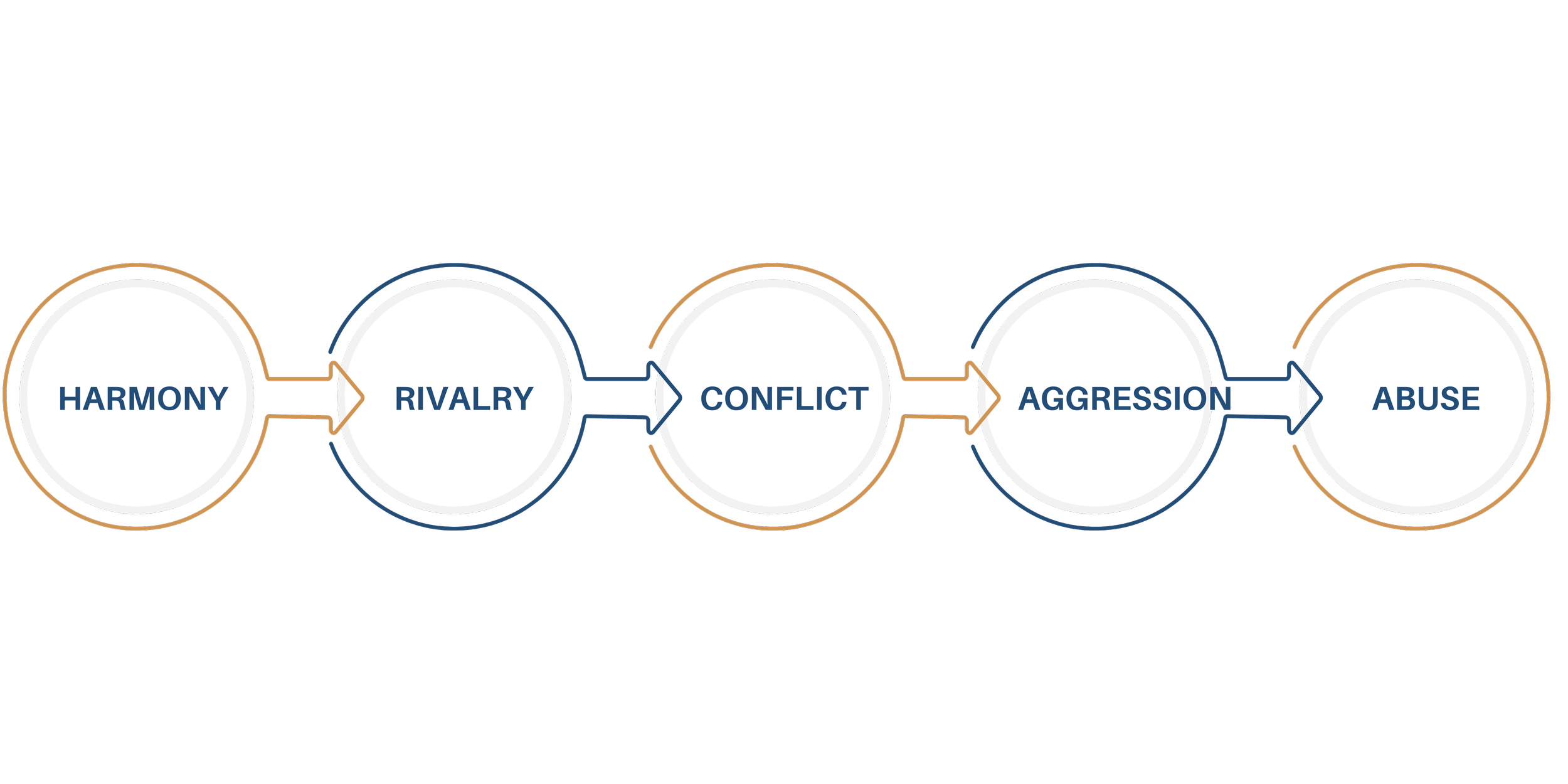
Harmony
Most families have many moments of harmony between siblings: older siblings teaching and helping younger siblings; having built-in playmates who create, commiserate and bond over shared joys and challenges; appreciating a best friend for life. That’s the goal, but does it happen on its own, and is harmony possible all the time? Most often not. All relationships take work, and rivalry and conflict between siblings are natural. With guidance and teaching of communication, problem solving and emotional regulation, harmony is possible – and provides skills for life.
Rivalry
It is natural for older siblings to feel displaced and jealous when a new sibling comes along. Competition for love, time, stuff and attention is normal and natural, and most siblings will have feelings of jealousy, envy, and competitiveness. As kids grow, it is also normal that competition in ‘skills’ such as academics, athletics, arts, or friendships will occur. These can be the seeds of rivalry that spur each other on - or become problematic. However, with intervention at a young age, before they become entrenched patterns or escalate further, rivalry can instead provide seeds of opportunity for growth, self-esteem, and empathy, enabling the uniqueness of each individual child to blossom.
Constructive Conflict
When people live together - children and adults - disagreements and problems arise. With help and guidance from parents or caretakers, they can provide opportunities for growth and development of skills with lifelong benefits.
Destructive Conflict
Conflicts between siblings can, however, become destructive, and as a result of feeling anger or frustration, lead to mild aggression – one-sided or mutual name calling, insulting, and mild physical aggression suck as hitting. If left unchecked, this can escalate into greater and more destructive forms of physical and mental or psychological aggression.
Aggression
Mild aggression can become severe when issues and negative interactions are ignored or left unresolved, with no intervention from parents or guardians. These behaviours can include punching, hitting and other physical behaviours, including use of weapons; destruction of possessions; humiliation and other verbal and emotional behaviours that can cause harm. They can be mutual or one-sided, but will invariably impact both of the children or adolescents involved.
Abuse
Abuse is about power and control over another. It can be emotional, physical and sexual abuse. There are key distinctions that differentiate abuse from aggression. Abuse is:
~ One-sided: one child is the victim or harmed child and the other is the perpetrator or harmer.
~ There is a power differential based on age, size, cognition or status in the family.
~ There is an intent to harm.
~ It is repetitive, persistent, and therefore conducive to a constant state of fear, anxiety and stress.
~ The harmful behaviours are not age-appropriate; hitting, for example, may be appropriate for toddlers, but not for older children.
Modified from Classification of Sibling Dynamics,Tucker, Whitworth, & Finkelhor, SAARA website. © 2025 by The Authors
Language Clarifications and Definitions
‘Victim’ and ‘perpetrator’ are the terms that have traditionally been used with all forms of abuse, including within the criminal justice system. Because there is an awareness that the ‘perpetrator’ in sibling abuse is also a child or adolescent (therefore considered also a victim), there is discussion within the field questioning the terminology. Thus:
~ Victim may also be referred to as ‘harmed’ or ‘targeted’. Also, most people victimized as children will later choose to refer to themselves as Survivors
~ Perpetrator may also be referred to as ‘harmer’, ‘offender’, or ‘aggressor’
~ Siblings can refer to full, half- and step-siblings, as well as cousins or other children living the majority of their time in the same home
~ Child Abuse refers to abuse inflicted upon a child by an adult
~ Sibling Bullying vs. Sibling Abuse - see below
The continuum of sibling interactions is to clarify the often-unclear lines from healthy to traumatic sibling behaviours.
Accurately naming an experience is a key piece in the process of understanding, intervening in, and healing from trauma. Because so little is known about sibling abuse – with the name itself seldom seen in the public domain – here is some basic information about the issue. This is important for:
~ Survivors of sibling abuse who may not be aware that what they experienced as children was not just sibling rivalry but was actually sibling abuse, and the profound implications of being an abuse survivor
~ Perpetrators/harming siblings who may benefit from clarity in understanding the nature and impact of their behaviour, why they behaved that way, and the negative long-term impact they may also experience
~ Adults with siblings who may be struggling with their sibling relationships
~ Parents and guardians who are responsible for the well-being and healthy development of children and adolescents
~ Helping professionals to know if and when to intervene
Sibling Abuse
As in other forms of family violence and abuse, sibling abuse falls under three categories; physical, emotional and sexual, and can range from mild to severe. As seen above, key factors that classify it as abuse are:
~ Intent to harm
~ Power and control
~ One-sided
~ Power differential (age, size, cognition, status)
~ Persistent, long-lasting
~ Behaviour is not age-appropriate
Here is a brief introduction to these forms of abuse when involving siblings.
Sibling Emotional/Psychological Abuse
The expectation that siblings will tease, name-call and verbally fight is so common that we seldom consider its implications. But these seemingly-innocuous behaviours can have deep impact, in part because they can continue from early childhood into adulthood, largely ignored. Part of the harm is due to the repeated nature, often for years, of these verbal and emotional ‘attacks’ from someone who is supposed to – and usually does – love the person they are harming. And the person harmed, often a younger brother or sister, believes their words to be true. Survivors often report that it is worse than the physical abuse they experienced because the negative messages are deeply internalized. “The bruises go away but the voices in your head don’t.” Additionally, physical or sexual sibling abuse is usually accompanied by emotional abuse.
While they range from mild to severe, some of these behaviours include:
~ Name-calling
~ Belittling
~ Insulting or degrading one’s appearance or abilities
~ Ignoring or shunning
~ Threatening physical harm or frightening acts
~ Publicly humiliating, including on social media
~ Destroying personal possessions; harming pets
~ Excessive controlling and/or bossing
~ Denying privileges
~ Manipulating and coercing them to do things they may not want to do
~ Forcing siblings to do their work/chores
Sibling Physical Abuse
Brushed off as roughhousing or fighting, and sometimes seen as play, physical abuse between siblings is often accepted as ‘normal’, even though the same behaviour from an adult or a peer would be cause for alarm. But sibling physical abuse is not mutual, as a fight would be, and it disguises the actual harm it can cause, particularly since it almost always occurs alongside emotional abuse. Some common behaviours include:
~ Hitting, biting, slapping, shoving, punching, pulling hair, restraining, confining
~ Excessive tickling (considered an ‘unusual’ form of violence but can feel like torture)
~ Severe, injurious and harmful life-threatening behaviours: strangling, attempted drowning, use of a weapon (or any object used as a weapon)
Sibling Sexual Abuse
Like physical and emotional sibling abuse, sibling sexual abuse (SSA) is the least discussed, explored and researched form of sexual abuse. It is also the most common, although data is difficult to obtain for a number of reasons including the shame involved in disclosure.
It has its own ‘continuum’ from natural, age-appropriate curiosity of the body to abuse, encompassing behaviours both with and without contact. Here is a brief distinction and some further information:
~ Sexual abuse with contact (from inappropriate kissing and affection, to touching or fondling, to rape)
~ Sexual abuse without contact (indecent exposure, forcing the victim to watch pornography, sexualized discussion)
~ SSA typically begins earlier and lasts longer than other types of child sexual abuse (ie from an adult)
~ The impact on mental health and interpersonal functioning is just as severe as sexual abuse by an adult caregiver
~ Most often it involves an older brother to younger sister, on average 5 years apart
~ Grooming of the victim is not uncommon due to ease of access and the love and trust that siblings share
~ Access to online pornography is a significant factor
~ It is more likely to incur involvement of Child Welfare or Child and Family Services and the criminal justice system
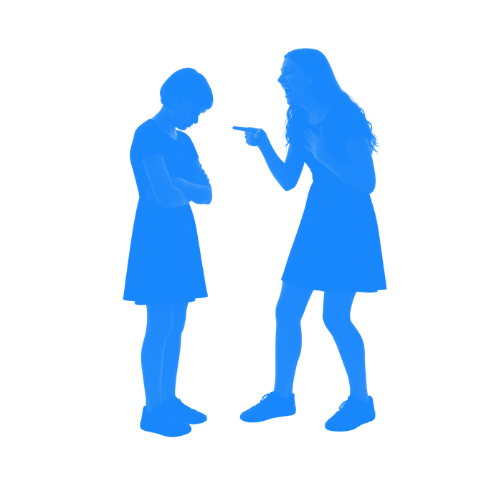

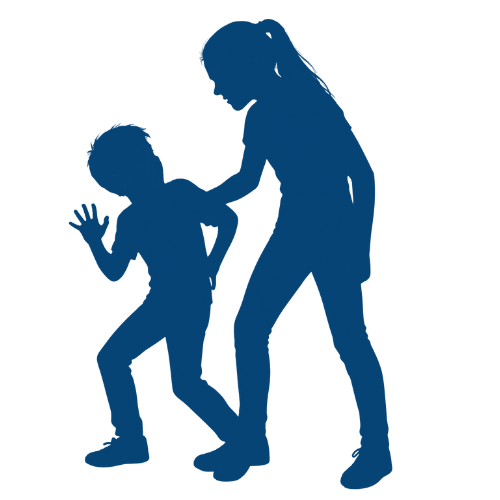
Prevalence
Although increasing, research on sibling abuse is limited. Below you’ll find some of the most commonly referenced and accepted data, with more to come, given recent interest in the field.
~ All three categories of abuse of children occur more often from siblings than any other family members; it occurs at all ages, including violence directed at infants
~ More than 50% of all children experience violence from a sibling in the course of a year; up to 80% experience emotional/psychological maltreatment
~ The highest incidence of violence is with children aged 6-9; it drops for those aged 14 - 17 and is twice as common in all-boys vs. all-girls families
~ Rates of sibling violence are significantly higher than peer/bullying (35% versus 20%)
~ Between 35 - 40% of victims of sibling violence display trauma symptoms
~ 2 - 5% of children and adolescents experience sexual abuse by a sibling, affecting 1 in 5 families, with a child being 3 - 5 times more likely to be sexually abused by a sibling than anyone
~ Children with psychiatric and developmental disabilities are at greater risk of being abused
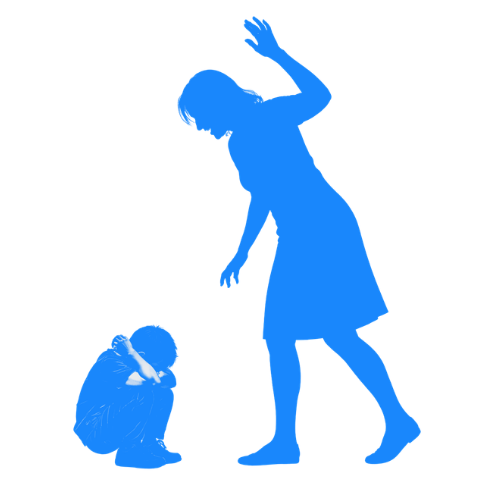

Impact
Research on the impact of abuse by a sibling has shown that it can have serious short- and long-term effects. The following are often found to be present for sibling abuse survivors:
~ Mental health issues: depression; anxiety; Complex-PTSD
~ Low self-worth; low self-esteem; shame
~ Self-harm; suicidal thinking, ideation, and/or attempts
~ Substance abuse, eating disorders, other addictive behaviours
~ Difficulties in intimate and peer relationships
~ Continuation of the role of victim or perpetrator of violence and abuse through adolescence and adulthood, within the family as well as externally, such as to or from peers, colleagues and in intimate relationships
~ Self-blame for disclosing - or not disclosing; guilt if they disclose and the harming sibling is then punished
~ People-pleasing; giving away one’s power; having an external ‘locus of control’ where one feels they have little control or power in their own lives
~ Potential for a constant state of fear/anxiety: as the victim, you never know when another attack might happen
~ Trauma response: Fight/flight/freeze/fawn - trauma remains in the body, and can be triggered by other, sometimes seemingly minor or unrelated events. This can continue long after childhood.
* NOTE: Sibling abuse also affects the harming sibling due to guilt they feel as a result of their own behaviours as well as the underlying issues that led to those choices. Many of the outcomes listed here may be present, as well as long-term risks for antisocial behaviour, illicit drug use, and criminal involvement.
Impact Due to the Silence of Sibling Abuse
There is an added burden due to the invisible nature of sibling abuse itself; other forms of abuse are seen and spoken of publicly - in the media, the classroom, etc. Sibling abuse is not. Even helping professionals receive little to no training about the issue.
Children - and adult survivors - can therefore feel like they are the only ones who experience or have experienced this; there seems to be no external ‘root cause’ for one’s difficulties. Unable to understand why they struggle with the issues and difficulties they have can leave them feeling deeply flawed, invisible, isolated and confused.
The very foundation of what defines ‘family’ creates further confusion - and long-term impact. How can the sibling they love hurt them? Why are their parents not protecting them? If they try to disclose, their parents may say it’s their fault, that they are making it up, blowing it out of proportion, or punish them - or they may simply ignore it. This can shatter not only their own foundation, but the foundation of the family itself, resulting in difficult sibling relationships or, often, estrangement from parents, siblings or both.
The silence of sibling abuse impacts the whole family - the harmed, the harmer, and the parents who may simply not know what to do. For further thoughts, see Prevention, Intervention … and Healing, here.
Risk Factors
There are factors that increase the likelihood of all forms of family violence. However, just as there is no “one size fits all” profile of any harmful relationship, neither are there identical factors in families of children and adolescents who are perpetrators or victims of sibling aggression and abuse.
Because every family and each individual within each family is unique, families may exhibit a few or many of the following indicators of potential abuse. Note that there are:
SPECIFIC elements within families that may increase the risk of sibling aggression and abuse
GENERAL risk factors for all forms of abuse (child abuse, intimate partner violence, etc.), including siblings
UNIQUE to sibling violence/aggression/abuse
~ Comparing: It is natural – but potentially problematic – to compare siblings; the impact of a parent’s message that one child is less than or better than their sibling can be profound, particularly if other risk factors exist in the family
~ Favouritism: A favourite child can be either the harmer OR the harmed
~ Labelling: “The Smart One,” “The Cute One,” “The Troublemaker” etc. are all roles that may feed into resentment or anger and lead to aggression or abuse
~ Older siblings put in charge of younger siblings: Although sometimes necessary, and often successful, this gives the ‘babysitting’ child more responsibility than they may be capable of, and puts them in a position of power over their sibling. As in child abuse, it is rare for the harmed child to inform the parents when this dynamic results in an abuse of that power.
~ Access and time: Siblings have round-the-clock access to each other; after-school hours can be especially problematic
~ Gender and birth order: First-borns are more likely to be offenders; younger females are more often victims; siblings close in age are at greater risk, with closely-aged brothers the most violent
~ Parental action or inaction: Neglect; lack of supervision; coercive parenting style; taking sides; blaming or shifting responsibility to the victim; inability to resolve or to respond appropriately to sibling conflict; normalizing abuse by ignoring or minimizing aggressive behaviours
~ Denial: As long as it continues to be normalized, remains hidden, out of the public domain, nobody needs to take responsibility for the harm and the damage done to children. “If sibling abuse isn’t a thing, there is nothing to take responsibility for.”
GENERAL to all types of family violence & abuse:
~ Lack of resources (financial; space; time; emotional, social, and community supports, etc.)
~ Stress; marital conflict
~ Family disorganization and chaos
~ Dysfunctional communication
~ Parents with addiction, mental health issues
~ Witnessing or victim to violence: spousal/intimate partner or child abuse (physical, sexual, emotional, including criticism and shaming)
~ Cultural norms that condone abuse of power; hierarchy of power; authoritarian parent(s)
~ General acceptance of violence
~ Spanking or corporal punishment used in the home

Sibling BULLYING vs. Sibling ABUSE
The terms sibling bullying and sibling abuse are often considered interchangeable, given they align in many ways: both involve behaviour that is harmful physically, emotionally and/or mentally as well as sexually; the bully (or perpetrator) may use language, physical aggression, manipulation and shaming; there is an imbalance of power such as in age, size, cognitive capacity, and status.
Bullying, however, is generally considered to be a social issue between peers. It includes a wide range of behaviours from mild to severe all under the same umbrella, and does not take into consideration factors unique to sibling dynamics and family systems. Those bullied by their peers do not have to sit across from their bully at the dinner table, or share a bedroom with them.
Rates of sibling violence are significantly higher than peer bullying (35% versus 20%) and sibling abuse is more strongly associated with depression and self-harm than peer bullying.
Abuse is associated and aligned with family violence - child, spousal and elder abuse. Thus, it is our commitment to look at sibling abuse as part of the Family Violence paradigm to ensure it is given the same attention in terms of policies, programming, research and training.
Public perception is important; language guides our perception. While bullying research has led to invaluable programming, advocacy and education, maintaining a distinction between peer behaviours and sibling behaviours will better serve our understanding of the unique differences between them.
NOTE: All information and data are from a variety of sources; see Resources