
Prevention, Intervention and Healing

“It’s important to put intentional strategies into place. When children lacking these skills are left to their own devices, they flounder. Every day, parents have so many opportunities to help children develop a more positive relationship with one another.”
~ Laurie Kramer, PhD, Creator, Fun with Sisters and Brothers Program
Sibling conflict is often a parent’s and caretaker’s greatest challenge. Conflict is inevitable; abuse is not. Ensuring siblings don’t cross those lines into harmful aggression and abuse requires prevention, planning, strategizing, communication - and seeing each child for the unique being that they are.
What Do Sibling Abuse Survivors Say?
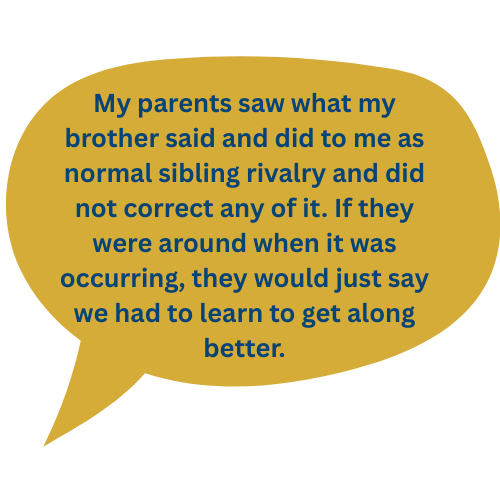
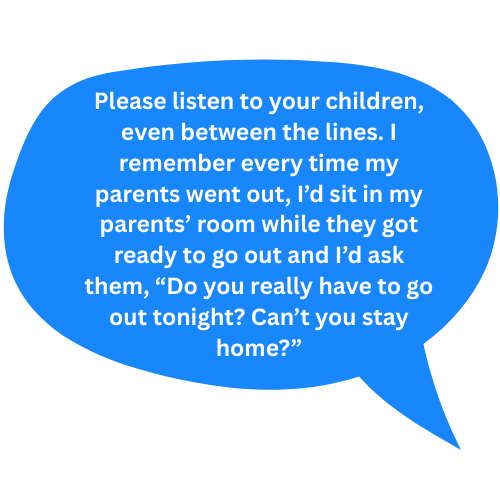
In his ground-breaking research, Dr. Vernon Wiehe, one of the earliest researchers of sibling abuse, asked survivors what they feel needs to be done to protect children from being abused by siblings. Their responses have stood the test of time and support research findings in the years since.
1. Build awareness.
2. Listen to children and believe them.
3. Provide good supervision to children in the absence of parents.
4. Encourage openness about sex.
5. Give children permission to own their own bodies.
6. Seek help if sibling abuse is occurring in the family.
7. Violence-proof the home.
8. Reward good sibling interactions.
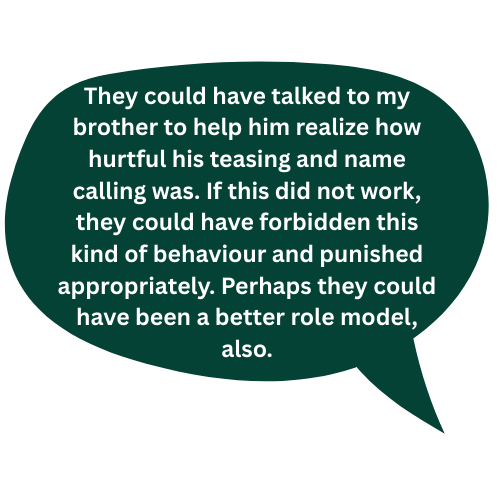
Quotes and suggestions from Sibling Abuse: Hidden Physical, Emotional, and Sexual Trauma, by Vernon R. Wiehe
Prevention First
Parents and caregivers hold the key
Letting children find solutions to their conflicts is essential … once they have the skills to do so. Teaching siblings skills to resolve their own conflicts when they are young, while nurturing and supporting appropriate behaviours, will benefit them throughout their lives.
That usually doesn’t happen on its own. Parents and caregivers may wish to seek out parenting courses, coaching or counselling.
If sibling aggression is occurring, intervention is required.
If abuse is occurring, seeking professional help is necessary.

Research shows that less parental involvement is best in conflicts between siblings. But that doesn’t mean they don’t need help.
What doesn’t work?
~ Ignoring the conflicts and leaving them to ‘work it out’ OR
~ Jumping in and ‘fixing’ the situation
What does work? Early teaching and modelling
~ Setting clear ground rules, including no-hitting rules
~ Problem-solving and conflict management strategies
~ Emotional self-regulation
~ Good communication skills
Then they can work it out themselves!

What can parents and caregivers do to nurture positive sibling relationships?
Here are some helpful tips from the Sibling Aggression and Abuse Research and Advocacy Initiative (SAARA).
There are also great books and free or low-cost parenting programs online and in most communities.
Promoting Positive Sibling Relationships: Practical Tips for Caregivers
1. Treat children fairly, without favouritism. Value each child for who they are.
2. Resist comparing or labeling children. Labels like “the funny one” or “the smart one” seem harmless but can cause resentment and influence how children think about themselves.
3. Encourage and praise positive sibling interactions. Help children identify what they like about their siblings and encourage connections and shared interests between them.
4. Help children to identify and express their feelings. Teach children to pause and then name and communicate their feelings to practice coping and emotion management skills.
5. Establish a family “no hitting” rule. No adult or child should hit anyone else in the family. Insults, threats, and any form of physical hurting should also be off-limits.
6. Teach constructive conflict resolution. Don’t take sides or solve the conflict for them. Coach children to work together to identify the problem causing the conflict, see differing feelings and perspectives, and propose and enact solutions.
7. Model good management of your emotions when interacting with others, including your children. Take a breath before reacting.
8. Model constructive conflict with others. Be an example of a respectful and solution-focused person during conflict. Don’t focus exclusively on the harm done. Figure out how to move forward.
9. Teach children body autonomy. Children who feel in control of their own bodies, know the correct names for all body parts, and respect others’ body boundaries are safer children.
10. Know when to seek help and education. Sibling conflict and rivalry shouldn’t leave physical or emotional injuries. Pediatricians, guidance counselors, school nurses, and family resource centers can offer advice and resources.
NOTE: All information and data are from a variety of sources; see Resources

Some Intervention Strategies
If you are a parent, caregiver, professional, family member or friend, and you suspect interactions between siblings are problematic, it is important to take it seriously.
If a child discloses harm or abuse - even hints at it - take it seriously. Believe them. Investigate. Below we offer some tips and questions you can ask; if you need further support, please seek professional guidance.
Approaches and questions for parents and caregivers
Being watchful of siblings and their interactions is especially important when you have an awareness of the nature, levels, and impact of harmful sibling aggression and abuse. Below are some approaches that can be taken and questions that can be asked to determine if the behaviour between siblings is harmful and may require intervention.
~ Be invitational. Enquire about the nature of sibling’s times together with curiosity and openness, setting the stage for opening lines of communication about these important relationships.
~ If you have concerns, address them, learning and modelling good listening skills - giving your full attention; seeking to understand; listening without judging or reacting emotionally and ensuring to treat the siblings equitably. It might not come naturally; we all need to learn these skills.
It is important to address the specific behaviours that have taken place. The following questions can help to clarify if the behaviour has crossed the line from rivalry into aggression or abuse:
~ Is the behaviour age-appropriate?
~ What is the purpose of the behaviour?
~ Has it escalated over time?
~ Is physical violence (e.g., hitting, kicking, shoving) occurring after the toddler years?
~ Is there a significant age/size/power differential between the siblings?
~ How often and how long has the behaviour been occurring?
~ Is it physically or emotionally harmful or is there a serious risk of harm?
~ Is the behaviour planned or patterned, suggesting an intent to harm?
~ Does one or more sibling often feel victimized, targeted, or afraid?
~ Does one or more sibling easily and/or often express frustration, anger or rage?
~ Does a sibling seem to be hesitant to consent to certain games or activities, or no longer want to play or hang out with a sibling?
~ Do you sense coercion or manipulation?



NOTE: All information and data are from a variety of sources; see Resources


… and Healing
Being harmed by a sibling can have lifelong consequences.
Being the harming sibling, or the parents or caregivers, also has impacts. It affects the whole family system in ways that are difficult and complex.
If this is happening or has happened in your family, seek to understand, seek help, seek treatment, seek ways to heal.
For Survivors
Many sibling abuse survivors have spent much of their lives feeling unheard, unseen, unsupported. While some have always known that the harm they received from a sibling was wrong and inappropriate, others may have only seen it as normal, not recognizing that they even were victims of abuse. Others may have sought help and worked through the trauma. It’s important to remember that every experience is different - and each is valid.
If you are an adult and know (or suspect) that sibling abuse may have been a part of your childhood experience, it is important to talk about it and get the help you may need to heal from the trauma.
Many survivors say that they have not received an apology or an acknowledgement from their abusive sibling; research confirms that it is unlikely to happen. Perhaps, as more awareness and conversations takes place in the public forum, that will change.
Some other thoughts:
~ You are not alone. Remember the numbers and percentages of children who are or have been abused by a sibling - it is highly likely you already know other survivors.
~ You are not to blame.
~ Seek help from a therapist or counsellor who is familiar with and understands the implication of abuse by a sibling. There is a wide range of evidence-based therapies that have emerged from recent research into trauma; they are worth exploring to find your best fit.
~ There are online social media groups that offer support and camaraderie for survivors.
~ You always have choice of whether or not you want to (or can) see your sibling. For many, going ‘no contact’, while very difficult to do, has been a great help. What is most important is to understand what is in your best interest, and what will help you most to heal.


For Those Who Have Harmed
There are reasons children and adolescents harm their siblings. Perhaps they feel ignored or invisible within the family. Perhaps they witnessed violence between their parents, or they were abused by a parent or caregiver. Perhaps they are bullied at school or have difficulty making friends. Perhaps they are jealous of their sibling. Perhaps they don’t have enough time or space for themselves because their younger sibling drives them crazy, wanting to play with them, use their things, follow them around, copy them – and then they have to babysit them!
Any of these circumstances could lead to frustration, anger, resentment, or other feelings that you don’t know what to do with. In some families, it’s easy to take it out on a sibling.
Patterns of abuse can stick, right into adulthood. If you are the harmer, perhaps you are no longer violent, but the abuse may continue verbally and mentally. You may or may not be aware of the harm your behaviour causes or has caused because it’s not talked about. And it is difficult to acknowledge behaviour one isn’t aware of causing – especially if you have been harmed or victimized in some way yourself.
The problem is that the past lives on inside, and, if not looked at, may impact one’s life well into adulthood. Problems with intimate relationships as well as with friends and colleagues, work, substance abuse and other addictions, difficulty managing anger … all of this and more can be a result of the unresolved trauma from having engaged in aggressive or abusive behaviour, and the issues that led to it. There are many types of therapies that provide a safe place to explore these complex and difficult feelings and behaviours.
Everyone has the right to a happy, fulfilling life, and one’s past does not have to define one’s future.
For Parents and Caregivers
To know your child has harmed another of your children may be the most difficult thing a parent experiences. A society that has normalized all sibling conflict into harmless and perhaps helpful rivalry - along with the thousand other stressors in family life - may prevent parents from even knowing that harm may be occurring. Add to that the fact that children tend not to disclose abuse – in part because they too see it as normal, they have not been believed in the past, or they are threatened into silence. It’s not safe to speak out.
It is never too late to intervene, and it’s never too late to get help and treatment. While the message is clear that parents and caregivers are positioned to help the most, it is also understood that it happens in all families, across all walks of life.
Once parents and caregivers are aware that there is aggression and/or abuse between their siblings, seeking help is important. It is likely that treatment or therapy will be of a ‘family system’ nature, looking at all of the family members as interconnected players. Depending on the nature of the abuse, for example, in cases of sibling sexual abuse, it may be recommended that the offending child be removed from the home. While that may bring feelings of shame or embarrassment to the parents or caregivers, it is important to recognize that the long-term safety, security, and mental health of both/all the children involved must be prioritized.
While it is certainly difficult to deal with these issues after they have already impacted the well-being of ones’ children, the benefits of seeking help, treatment and support far outweigh the detriments of keeping aggression and abuse hidden.


NOTE: All information and data are from a variety of sources; see Resources

STAY TUNED!
We are eager to share this research and our knowledge and experience of sibling conflict, aggression and abuse with individuals and organizations across Canada. To that end, we will be developing and sharing creative interventions for survivors and others affected by the issue that can be used within the schools and our communities. Contact us to get involved!